
乘法快速幂相关总结 & LeetCode
乘法快速幂相关总结 & LeetCode - 50. Pow(x, n)
- 递归计算 (a n) % mod
- 非递归计算 (a n) % mod
- 计算 ( a * b ) % mod
- 配合 ( a * b ) % mod和乘法快速幂
- XYNUOJ - 1872. 次方求模题解
- LeetCode - 50. Pow(x, n)题解
递归计算 (a n) % mod
递归计算其实是更容易理解的:
- 为了求an,我们先递归去求出an/2,得到结果记录为
halfRes; - 然后如果
n为偶数,很好办,再乘以一个halfRes就可以了(再取模一下),也就是可以返回halfRes*halfRes; - 但是如果
n为奇数的话,就需要再乘以一个a,然后再返回;


代码:
1 2 3 4 5 6 7 8 9 10 11 12 |
static long pow_mod(long a, long n, long mod) { if (n == 0) // a^0 = 1 return 1; // 先求一半的 --> 你先给我求出 a ^ (n/2) 的结果给我 long halfRes = pow_mod(a, n >> 1, mod); // n >> 1 --> n/2 long res = halfRes * halfRes % mod; if ((n & 1) != 0) // odd num res = res * a % mod; return res; } |
非递归计算 (a n) % mod


假设一个整数是10,如何最快的求解10的75次方。
- ①
75的二进制形式为1001011; - ②
10的75次方 = **1064 × 108 × 102 × 101**; - 在这个过程中,我们先求出101,然后根据101求出102,再根据102求出104。。。。,最后根据1032求出1064,即
75的二进制数形式总共有多少位,我们就使用了多少次乘法; - ③ 在步骤②进行的过程中,把应该累乘的值相乘即可,比如**1064**、108、102、101应该累乘,因为
64、8、2、1对应到75的二进制数中,相应位上是1;而1032、**1016**、104不应该累乘,因为32、16、 4对应到75的二进制数中,相应位是0;
1 2 3 4 5 6 7 8 9 10 |
static long pow_mod2(long a, long n, long mod) { long res = 1; while (n > 0) { if ((n & 1) != 0) // 二进制最低位 是 1 --> (n&1) != 0 --> 乘上 x ^ (2^i) (i从0开始) res = res * a % mod; a = a * a % mod; // a = a^2 n >>= 1; // n -> n/2 往右边移一位 } return res; } |
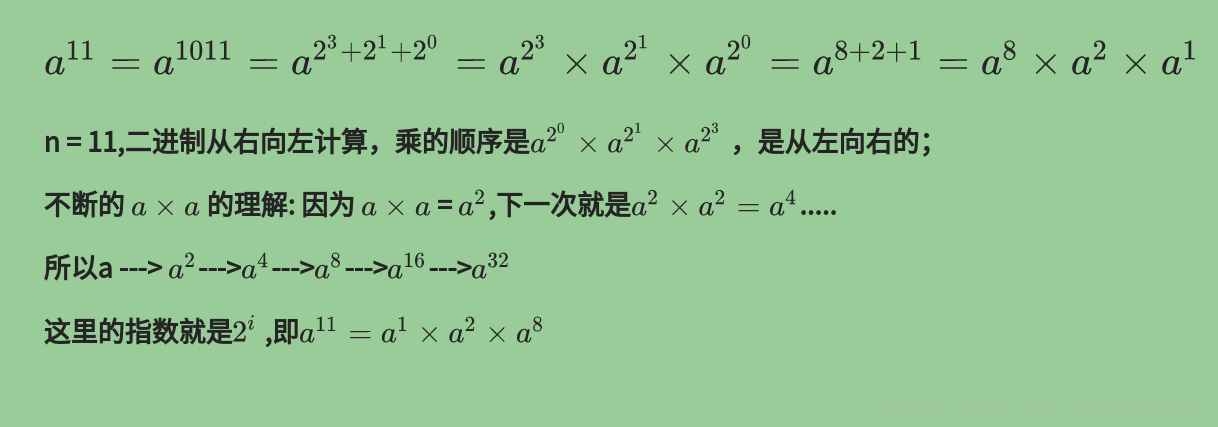
使用a ^ 11来模拟一下计算过程:

计算 ( a * b ) % mod

1 2 3 4 5 6 7 8 9 10 11 12 13 |
// 计算 (a * b) % mod static long mul_mod(long a, long b, long mod){ long res = 0; while(b > 0){ if( (b&1) != 0) // 二进制最低位是1 --> 加上 a的 2^i 倍, 快速幂是乘上a的2^i ) res = ( res + a) % mod; a = (a << 1) % mod; // a = a * 2 a随着b中二进制位数而扩大 每次 扩大两倍。 b >>= 1; // b -> b/2 右移 去掉最后一位 因为当前最后一位我们用完了, } return res; } |
配合 ( a * b ) % mod和乘法快速幂
可以使用非递归的乘法快速幂和上面的 (a*b) % mod 来计算快速幂,差别不大:
1 2 3 4 5 6 7 8 9 10 11 12 13 14 15 16 17 18 19 20 21 22 23 24 |
// 计算 (a * b) % mod static long mul_mod(long a,long b,long mod){ long res = 0; while(b > 0){ if( (b&1) != 0) // 二进制最低位是1 --> 加上 a的 2^i 倍, 快速幂是乘上a的2^i ) res = ( res + a) % mod; a = (a << 1) % mod; // a = a * 2 a随着b中二进制位数而扩大 每次 扩大两倍。 b >>= 1; // b -> b/2 右移 去掉最后一位 因为当前最后一位我们用完了, } return res; } //非递归 计算 (a^n) % mod 配合 mul static long pow_mod3(long a,long n,long mod){ long res = 1; while(n > 0) { if( (n&1) != 0 ) // 二进制最低位 是 1 --> (n&1) != 0 --> 乘上 x ^ (2^i) (i从0开始) res = mul_mod(res,a,mod) % mod; a = mul_mod(a,a,mod) % mod; // a = a^2 n >>= 1; // n -> n/2 往右边移一位 } return res; } |
XYNUOJ - 1872. 次方求模题解
题目链接
题目

完全的模板题,三种方法都可以通过:
1 2 3 4 5 6 7 8 9 10 11 12 13 14 15 16 17 18 19 20 21 22 23 24 25 26 27 28 29 30 31 32 33 34 35 36 37 38 39 40 41 42 43 44 45 46 47 48 49 50 51 52 53 54 55 56 57 58 59 60 61 62 63 64 65 66 67 68 69 70 71 72 73 74 75 76 77 78 79 |
import java.io.BufferedInputStream; import java.util.Scanner; /** * 题目链接: http://xyoj.xynu.edu.cn/problem.php?id=1872&csrf=mmofuzhUWGip3c6WlmhiFY6bLxeVHZta */ public class Main { //提交时改成Main //递归 计算 (a^n) % mod static long pow_mod(long a,long n,long mod){ if(n == 0) // a^0 = 1 return 1; // 先求一半的 --> 你先给我求出 a ^ (n/2) 的结果给我 long halfRes = pow_mod(a, n >> 1, mod); // n >> 1 --> n/2 long res = halfRes * halfRes % mod; if( (n&1) != 0) // odd num res = res * a % mod; return res; } //非递归 计算 (a^n) % mod static long pow_mod2(long a,long n,long mod){ long res = 1; while(n > 0) { if( (n&1) != 0 ) // 二进制最低位 是 1 --> (n&1) != 0 --> 乘上 x ^ (2^i) (i从0开始) res = res * a % mod; a = a * a % mod; // a = a^2 n >>= 1; // n -> n/2 往右边移一位 } return res; } // 计算 (a * b) % mod static long mul_mod(long a,long b,long mod){ long res = 0; while(b > 0){ if( (b&1) != 0) // 二进制最低位是1 --> 加上 a的 2^i 倍, 快速幂是乘上a的2^i ) res = ( res + a) % mod; a = (a << 1) % mod; // a = a * 2 a随着b中二进制位数而扩大 每次 扩大两倍。 b >>= 1; // b -> b/2 右移 去掉最后一位 因为当前最后一位我们用完了, } return res; } //非递归 计算 (a^n) % mod 配合 mul static long pow_mod3(long a,long n,long mod){ long res = 1; while(n > 0) { if( (n&1) != 0 ) // 二进制最低位 是 1 --> (n&1) != 0 --> 乘上 x ^ (2^i) (i从0开始) res = mul_mod(res,a,mod) % mod; a = mul_mod(a,a,mod) % mod; // a = a^2 n >>= 1; // n -> n/2 往右边移一位 } return res; } public static void main(String[] args) { Scanner cin = new Scanner(new BufferedInputStream(System.in)); int T = cin.nextInt(); while(T-- > 0){ int a = cin.nextInt(); int n = cin.nextInt(); int mod = cin.nextInt(); // System.out.println(pow_mod(a,n,mod)); // System.out.println(pow_mod2(a,n,mod)); System.out.println(pow_mod3(a,n,mod)); } } } |
LeetCode - 50. Pow(x, n)题解
题目链接
题目

解析
这个题目和普通的求幂不同的是:
其中
x(底数)是double类型的,且n是范围是Integer范围的(可正可负) :要注意的就是当
n为负数的时候,我们可以转换成求1.0 / pow(x,-n);还一个很重要的地方就是当
n = Integer.MIN_VALUE的时候要特殊处理,因为整形范围是-231到231-1,所以或者我们使用long来存转换的数,或者特殊判断一下;递归求解:
两种写法意思一样,第二种写法更加简洁:
1 2 3 4 5 6 7 8 9 10 11 12 13 14 15 16 17 18 19 20 21 22class Solution { public double myPow(double x, int n) { if (n > 0) { return pow(x, n); } else { if (n == Integer.MIN_VALUE) { return 1.0 / (pow(x, -(Integer.MIN_VALUE + 1)) * x); // MAX_VALUE = -(Integer.MIN_VALUE + 1) } return 1.0 / pow(x, -n); } } public double pow(double x, int n) { if (n == 0) return 1; double half = pow(x, n / 2); if (n % 2 == 0) return half * half; else return x * half * half; } }
1 2 3 4 5 6 7 8 9 10 11 12 13 14 15 16 17 18 |
class Solution { public double myPow(double x, int n) { if (n == 0) return 1.0; if (n < 0) { if (n == Integer.MIN_VALUE) { // return 1.0 / (myPow(x,-(Integer.MIN_VALUE+1)) * x); return 1.0 / (myPow(x, Integer.MAX_VALUE) * x); } return 1.0 / myPow(x, -n); } double half = myPow(x, n / 2); if (n % 2 == 0) return half * half; else return x * half * half; } } |
非递归求解:
三种写法的意思都是一样,只不过处理Integer.MIN_VALUE的方式不同而已。
1 2 3 4 5 6 7 8 9 10 11 12 13 14 15 16 17 18 19 20 21 |
class Solution { public double myPow(double x, int n) { if (n == 0) return 1.0; if (n < 0) { if (n == Integer.MIN_VALUE) { return 1.0 / (myPow(x, Integer.MAX_VALUE) * x); } else { return 1.0 / myPow(x, -n); } } double res = 1.0; while (n > 0) { if ((n & 1) != 0) res *= x; x = x * x; n >>= 1; } return res; } } |
1 2 3 4 5 6 7 8 9 10 11 12 13 14 15 16 17 18 19 20 |
class Solution { public double myPow(double x, int n) { if (n == 0) return 1.0; double res = 1.0; if (n < 0) { x = 1 / x; n = -(1 + n); // for Integer.MIN_VALUE res *= x; // x is 1/x because n is -(n+1) so should do this } while (n > 0) { if ((n & 1) != 0) res *= x; x = x * x; n >>= 1; } return res; } } |
1 2 3 4 5 6 7 8 9 10 11 12 13 14 15 16 17 18 19 |
class Solution { public double myPow(double x, int n) { if (n == 0) return 1.0; long abs = Math.abs((long) n); // also for Integer.MIN_VALUE double res = 1.0; while (abs > 0) { if ((abs & 1) != 0) res *= x; x = x * x; abs >>= 1; } if (n < 0) return 1.0 / res; return res; } } |
本博客所有文章除特别声明外,均采用 CC BY-NC-SA 4.0 许可协议。转载请注明来源 xhj的博客!